

Animated Marketing Videos: Benefits, ROI & When They Work
An animated marketing video is a short animated film made to win attention, explain an offer or move someone closer to buying. Most marketing teams reach for animation for the same reasons: the product takes a paragraph to explain, visitors leave the homepage before they get it, and the ad account needs something that moves. Sometimes an animated film is exactly right. Sometimes a photo, a screen recording or a quick live-action shoot would do the job better and cost less.
This guide covers what animated marketing videos are good at, where they earn their keep, how to work out whether one is paying for itself and when to choose something else. It’s written for marketers deciding whether to commission a film, not for animators.
If you already know you want one, our marketing video production page covers how we make them.
Animated marketing videos at a glance
An animated marketing video pays off when the thing you sell is hard to picture, the message has to be the same everywhere it appears and you want one film you can cut into many. Set one goal before production starts and measure the film against it.
| Marketing goal | Film that fits | Typical length | Measure it by |
| Get noticed by a cold audience | Short animated ad or social cut | 15 to 30 seconds | Views to the end, clicks, cost per visit |
| Explain what you do | Explainer on the homepage or a landing page | 60 to 90 seconds | Play rate, watch-through, enquiries from that page |
| Show how a product works | Product explainer | 60 seconds to 2 minutes | Demo requests, trial starts, sales feedback |
| Answer a doubt before someone buys | Objection or FAQ film | 45 to 90 seconds | Conversion on the page it sits on |
| Help new customers get started | Onboarding or how-to film | 60 to 120 seconds | Fewer repeat questions to support |
If you can only make one, make the explainer that answers “what is this, and is it for me?” Most of the other versions can be cut from it.
What is an animated marketing video?
An animated marketing video is a short animated film made to win attention, explain an offer or move someone closer to buying. You’ll also see the terms animated videos for marketing, animated video marketing and animation marketing. They describe the same idea from slightly different angles: animation marketing is the practice, and the films are what it produces.
The common forms are explainer videos, animated ads and social cuts, product explainers, brand and story films, and onboarding or how-to films. Each is covered in the types section below.
The explainer is the most common, which is why “the benefits of explainer videos” and “the benefits of animated marketing videos” are usually the same conversation. Our full explainer video guide covers types, styles and length in more depth. For films aimed at a buying group, see our B2B explainer videos guide.
What sets animation apart from other marketing video is control. Every frame is designed, so you decide exactly what the viewer sees, in what order and for how long. That control is behind most of the benefits below.
Types of animated marketing videos
Pick the type from the job the film has to do, not from the style that looks most impressive. If you can only make one, start with the explainer; most of the others can be cut from it.
Explainer videos
An explainer says what you do and why it matters, usually in 60 to 90 seconds. It belongs on a homepage or a landing page, and it answers “what is this, and is it for me?” before a visitor leaves.
Short versions, usually 15 to 30 seconds, built to stop the scroll and send people somewhere. They have to work with the sound off, name the problem in the first seconds and get the brand in early. Our 30-second explainer video guide covers how to cut a longer film down to that length.
Product explainers and feature films
These show a product doing something specific: a workflow, a feature, a result the viewer couldn’t picture from a screenshot. They often run from a minute to two minutes.
Overwatch Data’s film is a good example. It opens on businesses facing a constant stream of cybercrime threats, from more platforms than just the dark web, and asks whether teams have a way to detect and analyse all of them. The film then presents Overwatch as a threat-intelligence operation: AI agents and fraud experts monitoring underground forums and marketplaces in near real time, so security teams can act on the findings. It ends on a clear promise: actionable intelligence, so those teams can focus on what they do best.
Brand and story films
These carry a mission, a cause or a customer’s situation, rather than a product walkthrough. Advance CTE’s film is a good example. It is aimed at education and workforce audiences and frames career technical education as a connected path for every learner, in a world of work that technology has made more interconnected. The film walks through co-design between education and industry, breaking silos between academic and technical education, and building belonging and confidence for learners. It closes with a call that it will take all of us to build that path.
Films made for an internal or company audience are a close cousin; our animated corporate videos guide covers that job separately.
Onboarding and how-to films
These help new customers get value quickly and cut down the questions that otherwise land on support. They can be a little longer than a marketing explainer, because the viewer has already chosen you and needs the steps.
Animation styles for marketing videos
The type is the job. The style is how the film looks. Pick the style by what the viewer has to see, not by what is fashionable.
| Style | What it does well | Typical marketing job |
| 2D character animation | Warmth, a person the viewer recognises, a situation they are in | Ads, brand stories, campaigns |
| Motion graphics | Processes, data, interfaces and abstract services, with type and diagrams | Product explainers, software launches, landing pages |
| 3D | A physical object from any angle, in use, or before it exists | Product pages, trade stands, machinery or packaging |
| Whiteboard | An idea drawn while it is explained | Processes, education, thought leadership |
| Mixed media | Photos or live footage with animation over the top | Origin stories, campaigns, hybrids |
A hybrid is common: real people on camera with animated screens or labels. For more films and what each style does well, browse our explainer video examples.
The benefits of animated marketing videos
These are the benefits we see in practice, each with the caveat that comes with it. None of them is automatic: a weak script animated beautifully is still a weak film.
1. It can show what a camera can’t
Software, data, money moving between accounts, a process inside a machine, a service that happens behind the scenes: none of it films well. Animation can draw the thing itself, and strip out everything that isn’t the point.
Prompt Vault’s film is a good example. It explains an AI data-governance product, which is about as invisible as a product gets. The film follows a single request as it passes through the product, shows sensitive details being swapped for tokens before the AI sees them, then shows the answer coming back with the data restored only for people who are allowed to see it. It ends with one next step: visit the website or schedule a call.
The caveat: if your product is easy to film and the look of it is what sells it, real footage may do more.
2. It makes a message easy to follow
Animation lets you introduce one idea at a time, keep everything else off screen and put words, pictures and voice in step with each other. A viewer who would skim a page of copy will often follow ninety seconds of well-paced film.
The caveat: that only works if the script is tight. Animation can’t rescue a message that tries to say six things.
3. It keeps your brand consistent
Colours, type, characters and tone are all designed to your brand guidelines, so a series of films looks like a set, and the tenth film matches the first. That’s much harder to guarantee across live-action shoots with different crews, locations and weather.
The caveat: consistency needs a style frame agreed early, and someone who owns it for the next film.
4. It’s easier to update and localise
When a screen changes, a plan is renamed or a new market opens, you can change the relevant scenes, swap the voiceover and re-export, rather than book a new shoot. Language versions are usually a new voice track and new on-screen text.
The caveat: ask for the project to be set up with editing in mind, so text and screens aren’t baked into the artwork.
5. One film becomes many
A finished master can be cut into a short ad, a sales-email version, a silent loop for an event screen and a set of clips for social, all from the same artwork. The section on cut-downs below lists the usual set.
The caveat: cut-downs are cheapest when they’re planned in the storyboard, not discovered after delivery.
6. It works with the sound off
A lot of marketing video is watched on mute, in a feed or at a desk. Animation can build the on-screen words into the design rather than bolting captions on afterwards, so the film still makes sense in silence.
The caveat: that has to be designed in. A film written purely for the voiceover will lose silent viewers.
What animation won’t do on its own is fix an unclear offer, find you an audience or replace distribution. A film is one part of a campaign, not the campaign.
When animated marketing videos work, and when they don’t
The honest answer to “are animated videos good for marketing?” is: when the subject suits them. Here’s the shortcut we use.
| Animation usually fits when… | Live action or something else usually fits when… |
| The product is software, data, finance or a process | The story depends on a real person, such as a founder or a customer testimonial |
| You’re explaining an idea, a change or a new category | You’re selling the look, feel or texture of a physical product |
| The message must be identical across markets and languages | You need to react to news or a trend this week |
| You want a recognisable character or a series | The proof is a real place, such as a venue, factory or clinic |
| The subject is sensitive or hard to film, such as health, children or money | A simple screen recording already answers the question |
A hybrid is common too: real people on camera with animated screens, diagrams or labels layered over the footage.
One thing animation is often wrongly ruled out for is emotion. A story-led film can carry feeling as well as footage can, and sometimes better, because it can show a situation without asking real people to relive it on camera. Bumbleance, a children’s ambulance service in Ireland, is a good example. The film follows one mother whose child needs hospital treatment every week, hours from home, before introducing the service and what it does for families. It ends with two clear actions: donate or book a journey.
Where animated marketing videos earn their keep
The same film can do a different job in each place it appears. These are the placements that most often justify the budget:
- Homepage and landing pages. An explainer near the top of a page answers “what is this?” before a visitor leaves. Our website explainer video guide covers placement, length and autoplay.
- Paid social and pre-roll. Short cuts built for the feed, with a hook in the first seconds and the brand early.
- Email. A thumbnail with a play button linking to the film, in welcome emails, nurture sequences and sales follow-ups.
- Sales conversations. A film a salesperson can send before or after a call, so the prospect can share it with colleagues who weren’t there.
- Events and screens. A silent, looping version for a stand, a lobby or a shop window.
- Onboarding and support. How-to films that answer the questions new customers ask most often.
Short ads are where animation has to work hardest, because there’s no time to warm up. Aroma Retail’s thirty-second spot opens with a question about the scent of a luxury resort, makes its product points in a few lines, and finishes on the web address. It’s built to be understood in one pass.
What makes an animated marketing video work
The films that pay off tend to share the same habits, whatever the style. Here’s the order we’d plan them in:
- Pick one viewer. Name who they are and what situation they’re in. “Everyone” isn’t a viewer.
- Pick one message. If the viewer remembers one sentence, which one should it be?
- Open on their situation, not your logo. The first few seconds decide whether anyone keeps watching.
- Answer the doubt. Name the reason someone might hesitate, and deal with it inside the film.
- Show, don't list. Let the viewer see the product or the outcome rather than hearing a feature list.
- End with one call to action. Book a call, start a trial or visit a page. One, not three.
Flamingo Tours’ film handles step four well. It promotes a beach resort on the Bulgarian coast and, rather than ignoring the obvious worry, it names it: some viewers will picture loud party resorts. The film answers that straight away, then runs through what the resort offers families and ends with a booking call to action.
How an animated marketing video is made
The process is the same whether the film is a 90-second explainer or a 20-second cut. Our explainer video production process guide sets out the stages in full. In short:
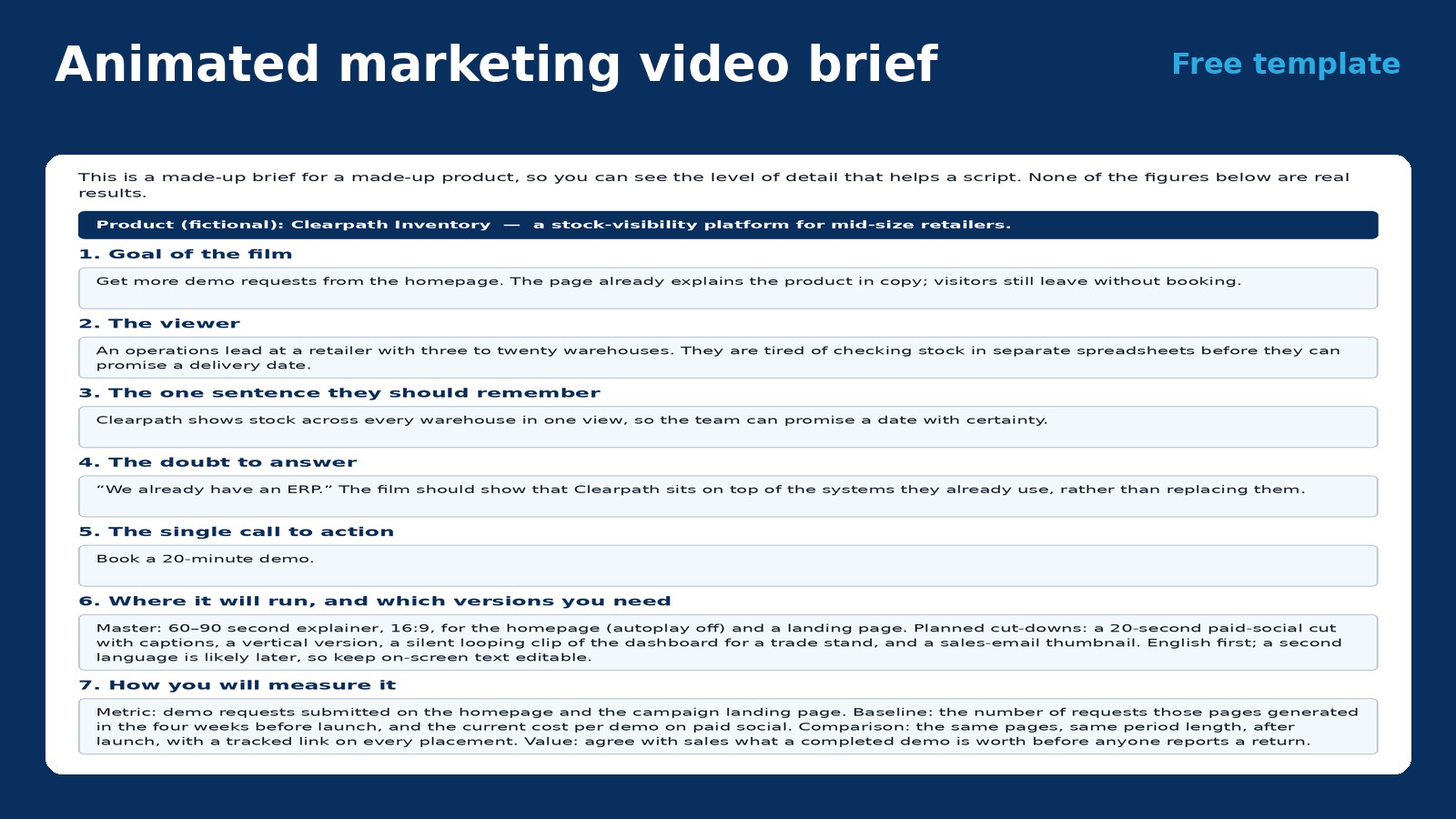
- Write the brief. Goal, viewer, one message, the doubt to answer, one call to action, where it will run, which cut-downs you need, and how you will measure it. The template below is a starting point.
- Write the script. Plain language, written for the ear, opening on the viewer’s situation. Our guide to writing a video script covers the structure.
- Storyboard and agree a style frame. A shot-by-shot plan, signed off before animation hours start. See our explainer video storyboard guide.
- Record the voiceover and choose music. The tone should match the brand. The words should still make sense if someone watches on mute, so plan the on-screen text here too.
- Animate, then revise. A typical project includes three rounds of revisions, one at each stage.
- Deliver the master and the cut-downs you planned in the brief, in the formats each channel needs.
A typical 60 to 90 second film takes about 4 to 6 weeks from kick-off to final delivery. Rushing the brief or the script is the usual reason that slips.
You can copy the headings below into a document, or download the free three-page template: a blank brief, a filled example for a fictional product, and a measurement checklist. The filled page is there to show the level of detail that helps a script. It is not a case study, and it does not use real results.
Free download: animated marketing video brief (PDF). Three pages: a blank brief to fill in, a filled example for a fictional product, and the measurement checklist.
Explainer video ROI: what it actually means
Return on investment for a video is simple to write down: the value the film created, minus what it cost, divided by what it cost. The hard part is the first term. Most articles about explainer video ROI quote big industry percentages; we can’t trace most of them to a primary source, and the only numbers that matter for your decision are your own.
Costs to count:
- Production (script, design, animation, voice, music).
- Promotion, including any paid media behind the film.
- Hosting and any video platform fees.
- Your team’s time on briefing and reviews.
- Updates and new versions later on.
Value to count, depending on the goal:
- New enquiries, trials or sales that you can reasonably trace to the film.
- A lower cost per lead or per sale on the campaigns that use it.
- Time saved in sales conversations, if prospects arrive already understanding the product.
- Fewer repeat questions to support or account teams.
Be careful with one distinction. “People who watched the film enquired” is an association. “The film created extra enquiries” is a cause, and it needs a fair comparison to back it up. Both are useful, but only the second belongs in an ROI figure. Decide which one you’re reporting before anyone asks.
How to measure an animated marketing video
You don’t need an analytics team to measure a film properly. You need to decide what you’re measuring before it goes live. Here’s a plan you can run:
- Choose one goal before production. Enquiries from the homepage, cost per lead on a campaign, demo requests, or fewer support tickets. Write it down.
- Record a baseline. Note how that number looks for a few weeks before the film launches.
- Tag every placement. Use separate tracked links for each channel, so you know where viewers came from.
- Track the video itself. Plays, how far people watch, and clicks on the call to action at the end.
- Run a fair comparison where you can. Show the same page with and without the film to similar visitors over the same period, rather than comparing this month with last month.
- Give it long enough. A few days of traffic rarely tells you much; let the test run until the numbers settle.
- Agree the value of the outcome. Work with sales or finance on what an enquiry or a saved support call is worth, and write down your assumptions.
A film with one clear call to action is far easier to measure than one with three. Reward Gateway’s commuter-benefits film shows the shape. It opens on the everyday problem of getting to the office, explains how the benefit works for employees, turns to what it does for the business, and closes with a single ask: book a demo. Every view can be tied to one measurable next step.
If the numbers are small, combine them with what sales and customers tell you. A film can clearly be helping people understand the product before the sample is big enough to prove it statistically.
Common mistakes with animated marketing videos
| Mistake | What to do instead |
| Choosing animation because it looks fun | Choose it because the subject suits it, using the table above |
| Opening with the logo or company history | Open on the viewer’s situation |
| Trying to say everything in one film | One viewer, one message, one next step |
| Writing only for the voiceover | Design on-screen words so it works on mute |
| No goal set before launch | Pick the goal and the baseline before production |
| Reporting views as ROI | Report the business result the film was made for |
| Making one film and stopping | Plan cut-downs and a refresh when the product changes |
| Quoting industry percentages you can’t source | Use your own numbers, with your assumptions written down |
Get more from one film: cut-downs and reuse
The cheapest way to improve the return on a film is to use it in more places. Plan these versions from the master before animation starts:
- A 15 to 30 second cut for paid social, usually the hook, the core message and the next step.
- A vertical version for stories and short-form feeds.
- A sales-email version that answers the question the email is about.
- A silent, looping version for events, receptions and shop screens.
- A captioned version for people watching at their desk with the sound off.
- Short clips of single features or steps, for help pages and social posts.
For more films and what each one does well, browse our explainer video examples.
What an animated marketing video costs and how long it takes
At Animation Explainers, projects typically range from $6,000 to $35,000 and beyond, depending on length, style and complexity. Our explainer video cost guide explains what moves the price. A typical 60 to 90 second animated explainer takes about 4 to 6 weeks from kick-off to final delivery.
You get three rounds of revisions, one at each stage, and you own the rights to your finished video. When you work out the return, remember to count the cut-downs: one production budget often covers several of the versions above.
Ready to make an animated marketing video?
We make animated marketing videos for brands that need something explained clearly, and we’ll tell you honestly whether animation is the right choice for your goal. If you’d like a second opinion on a brief, get in touch and tell us who the film is for and what you want them to do next. You can also see how we approach marketing video production, or browse more of our work at Animation Explainers.
FAQ
What are animated marketing videos?
Animated marketing videos are short animated films made to win attention, explain an offer or move someone closer to buying. They include explainer videos, animated ads and social cuts, product explainers, brand and story films, and onboarding films. Most marketing explainers run 60 to 90 seconds, and social cuts run 15 to 30 seconds.
What is animation marketing?
Animation marketing is the use of animated video and motion design to promote a product, service or cause. It covers explainer videos on a website, animated ads on social media, films for sales teams and how-to videos for customers. It’s most useful when the thing you’re promoting is hard to film or needs to look the same everywhere it appears.
What are the benefits of explainer videos?
An explainer video makes something complicated easy to understand, quickly. It can show what a camera can’t, keep a message focused, stay on brand across a series, be updated or translated without a reshoot and be cut into shorter versions for other channels. Those benefits depend on a tight script and one clear goal.
Are animated videos good for marketing?
Yes, when the subject suits them. Animation is a strong fit for software, data, finance, processes, new ideas and sensitive subjects. Live action is often better when the story is a real person, the product’s look and feel is what sells it, or you need to react to news quickly. A hybrid of the two is common.
How do you measure explainer video ROI?
Set one goal before production, record a baseline, then compare results with and without the film. Count the full cost, including promotion and your team’s time, and only the value you can reasonably trace to the film. Track plays, watch-through and call-to-action clicks, and agree with sales or finance what each outcome is worth.
How long should an animated marketing video be?
60 to 90 seconds for an explainer, and 15 to 30 seconds for a social ad. Product explainers can run up to two minutes when they need to show the product in use, and onboarding films can be a little longer. Plan the short cuts from the same master film.
Where should you use animated marketing videos?
Wherever someone needs to understand your offer before they act. The usual places are the homepage and landing pages, paid social, email, sales follow-ups, event screens and onboarding or help pages. One master film can be cut to suit each of them.
How much does an animated marketing video cost?
Animation Explainers projects typically range from $6,000 to $35,000 and beyond, depending on length, style and complexity. A typical 60 to 90 second animated explainer takes about 4 to 6 weeks. You get three rounds of revisions, one per stage, and you own the finished video.
Is animation better than live action for marketing?
Neither is better in every case. Animation is the stronger fit when the product is hard to film, the message must look the same in every market, or the subject is sensitive. Live action is often better when the story depends on a real person, the look and feel of a physical product is what sells it, or you need to react to news this week. A hybrid of the two is common. Our animated vs live action guide walks through the choice in more depth.
What type of animation works best for marketing videos?
The style that helps the viewer see the thing you need them to understand. Motion graphics suit software, data and processes. Character animation suits ads and stories that need warmth. 3D suits a physical product that has to be seen from every angle. Whiteboard suits a process explained step by step. Pick the style from the job, not from what is fashionable.
How long does it take to make an animated marketing video?
About 4 to 6 weeks for a typical 60 to 90 second explainer at Animation Explainers, from kick-off to final delivery, including script, storyboard, voiceover, animation and three rounds of revisions. Cut-downs and language versions are faster when they are planned in the brief, because the artwork is already built for editing.
Can one animated marketing video be used on every channel?
Yes, if you plan the cut-downs before animation starts. A 60 to 90 second master can become a 15 to 30 second paid-social cut, a vertical version, a silent loop for an event screen and a thumbnail for email. Language versions are usually a new voice track and new on-screen text, as long as that text was kept editable.
What’s the difference between an animated marketing video and an explainer video?
An explainer video is one type of animated marketing video. Marketing films also include short ads and social cuts, product or feature films, brand and story films, and onboarding or how-to films. The explainer is the most common, which is why the benefits are usually discussed together.
Which industries are animated marketing videos best for?
Any industry where the offer is hard to picture or has to be explained the same way every time. That often includes software, finance, data, professional services, education, healthcare and other processes that happen behind the scenes. Animation is not reserved for those sectors: it also works for a physical product, a charity or a destination when the story is clearer drawn than filmed.

What are animated marketing videos?
Animated marketing videos are short animated films made to win attention, explain an offer or move someone closer to buying. They include explainer videos, animated ads and social cuts, product explainers, brand and story films, and onboarding films. Most marketing explainers run 60 to 90 seconds, and social cuts run 15 to 30 seconds.
What is animation marketing?
Animation marketing is the use of animated video and motion design to promote a product, service or cause. It covers explainer videos on a website, animated ads on social media, films for sales teams and how-to videos for customers. It’s most useful when the thing you’re promoting is hard to film or needs to look the same everywhere it appears.
What are the benefits of explainer videos?
An explainer video makes something complicated easy to understand, quickly. It can show what a camera can’t, keep a message focused, stay on brand across a series, be updated or translated without a reshoot and be cut into shorter versions for other channels. Those benefits depend on a tight script and one clear goal.
Are animated videos good for marketing?
Yes, when the subject suits them. Animation is a strong fit for software, data, finance, processes, new ideas and sensitive subjects. Live action is often better when the story is a real person, the product’s look and feel is what sells it, or you need to react to news quickly. A hybrid of the two is common.
How do you measure explainer video ROI?
Set one goal before production, record a baseline, then compare results with and without the film. Count the full cost, including promotion and your team’s time, and only the value you can reasonably trace to the film. Track plays, watch-through and call-to-action clicks, and agree with sales or finance what each outcome is worth.
How long should an animated marketing video be?
60 to 90 seconds for an explainer, and 15 to 30 seconds for a social ad. Product explainers can run up to two minutes when they need to show the product in use, and onboarding films can be a little longer. Plan the short cuts from the same master film.
Where should you use animated marketing videos?
Wherever someone needs to understand your offer before they act. The usual places are the homepage and landing pages, paid social, email, sales follow-ups, event screens and onboarding or help pages. One master film can be cut to suit each of them.
How much does an animated marketing video cost?
Animation Explainers projects typically range from $6,000 to $35,000 and beyond, depending on length, style and complexity. A typical 60 to 90 second animated explainer takes about 4 to 6 weeks. You get three rounds of revisions, one per stage, and you own the finished video.
Is animation better than live action for marketing?
Neither is better in every case. Animation is the stronger fit when the product is hard to film, the message must look the same in every market, or the subject is sensitive. Live action is often better when the story depends on a real person, the look and feel of a physical product is what sells it, or you need to react to news this week. A hybrid of the two is common. Our animated vs live action guide walks through the choice in more depth.
What type of animation works best for marketing videos?
The style that helps the viewer see the thing you need them to understand. Motion graphics suit software, data and processes. Character animation suits ads and stories that need warmth. 3D suits a physical product that has to be seen from every angle. Whiteboard suits a process explained step by step. Pick the style from the job, not from what is fashionable.
How long does it take to make an animated marketing video?
About 4 to 6 weeks for a typical 60 to 90 second explainer at Animation Explainers, from kick-off to final delivery, including script, storyboard, voiceover, animation and three rounds of revisions. Cut-downs and language versions are faster when they are planned in the brief, because the artwork is already built for editing.
Can one animated marketing video be used on every channel?
Yes, if you plan the cut-downs before animation starts. A 60 to 90 second master can become a 15 to 30 second paid-social cut, a vertical version, a silent loop for an event screen and a thumbnail for email. Language versions are usually a new voice track and new on-screen text, as long as that text was kept editable.
What’s the difference between an animated marketing video and an explainer video?
An explainer video is one type of animated marketing video. Marketing films also include short ads and social cuts, product or feature films, brand and story films, and onboarding or how-to films. The explainer is the most common, which is why the benefits are usually discussed together.
Which industries are animated marketing videos best for?
Any industry where the offer is hard to picture or has to be explained the same way every time. That often includes software, finance, data, professional services, education, healthcare and other processes that happen behind the scenes. Animation is not reserved for those sectors: it also works for a physical product, a charity or a destination when the story is clearer drawn than filmed.